
Damp problems often look similar, but the cause changes the fix. Condensation forms when warm, moist air hits a cold surface, leaving water droplets on windows, walls, and corners. Penetrating damp usually comes from leaks through roofs, gutters, or cracked masonry, and it can leave localised patches that worsen after rain. Rising damp moves up from the ground through walls, often showing a tide mark and salt deposits near skirting boards.
Key takeaways
- Condensation shows as surface water and mould on cold walls, windows, and corners.
- Penetrating damp often creates localised patches that worsen after heavy rain.
- Rising damp typically forms a low “tide mark” and salt deposits up to 1 metre.
- Check ventilation and humidity first when mould appears in kitchens, bathrooms, or bedrooms.
- Inspect gutters, roof tiles, brickwork, and pointing when damp patches track external defects.
- Confirm rising damp by checking the damp-proof course and ground levels outside.
Condensation: key signs, common rooms, and why it forms
In the UK, the English Housing Survey reports that 8% of homes had damp problems, with condensation and mould the most common type. This matters because condensation can look like other damp issues, yet it usually needs different fixes. You can often reduce it by controlling moisture and improving ventilation, rather than treating walls.
Condensation forms when warm, moist air hits a colder surface and the water vapour turns into liquid. It tends to worsen in winter because indoor air stays warm while windows and outside walls cool down. Everyday activities add moisture fast: a shower can release about 1–2 litres of water into the air, and drying clothes indoors can add several litres over a day.
- Key signs: water droplets on windows, damp patches that appear in the morning, and black mould around frames or in corners.
- Common rooms: bathrooms, kitchens, and bedrooms with closed windows or blocked vents.
- Typical locations: cold bridges such as external corners, behind wardrobes, and around metal window frames.
Relative humidity gives a useful clue. When indoor RH stays above about 60% for long periods, mould risk rises, especially on colder surfaces.
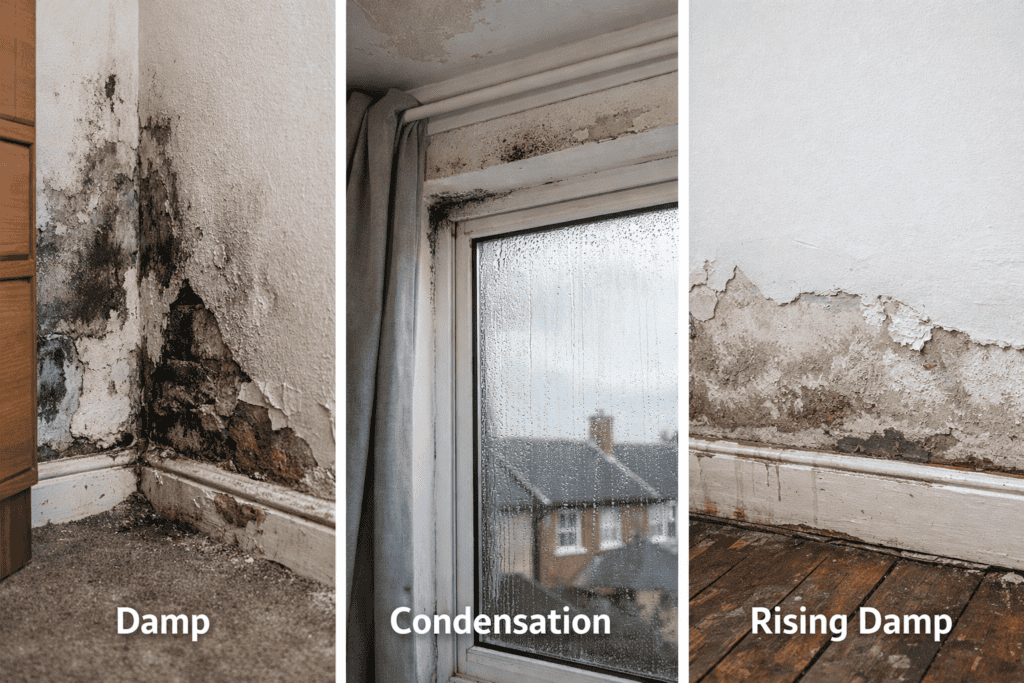
Penetrating damp: external entry points, internal clues, and typical patterns
Penetrating damp starts with an external defect that lets rainwater pass through the building fabric. Common entry points include cracked render, missing roof tiles, leaking gutters, and failed flashing around chimneys. Inside, the clues often sit higher up the wall or appear as isolated “islands” of staining rather than a uniform band. You may also see salt marks, crumbling plaster, or damp that worsens after wind-driven rain and eases in dry spells.
The broader check is simple: match the internal mark to what sits on the other side of that wall. If the stain lines up with a gutter joint, a downpipe, or a roof valley, the cause is usually outside. This approach also helps when assessing a potential purchase through what is property sourcing, because you can flag likely repair areas before commissioning surveys and quotes.
Rising damp: ground moisture, tide marks, and salt deposits
Rising damp starts in the ground and moves up through masonry by capillary action. Condensation forms from indoor humidity on cold surfaces, while penetrating damp enters sideways through an external defect. This difference changes where you see moisture and how you fix it.
| Type | Typical location | Common visual clues | When it gets worse |
|---|---|---|---|
| Rising damp | Ground floor, lower 0.3–1.0 m of walls | Tide marks, crumbling plaster, white salts | Persistent, often year-round |
| Condensation | Cold corners, windows, behind furniture | Surface water droplets, black mould | Winter, after cooking/showering |
| Penetrating damp | Any level, often near an external defect | Localised patching, staining, blistering paint | After rainfall and wind |
Rising damp usually shows a clear “tide mark” line and powdery salt deposits (efflorescence) as water evaporates and leaves minerals behind. Skirting boards can soften, timber ends may rot, and plaster often breaks down close to the floor. Unlike condensation, the dampness tends to stay low rather than spreading across cold upper walls.
Practical implications are straightforward: check the damp-proof course (DPC) and ground levels outside. Soil, paving, or render that bridges the DPC can let moisture bypass the barrier. If you need a formal diagnosis, use a surveyor who follows RICS guidance, since misdiagnosis can lead to unnecessary chemical treatments and replastering.
Quick checks to tell them apart: location, timing, and moisture behaviour
Misdiagnosis wastes time and money. A dehumidifier will not stop rainwater getting through a cracked render, and a chemical damp-proof course will not fix wet air condensing on a cold window reveal. You can usually separate condensation, penetrating damp, and rising damp with three quick checks: where it appears, when it worsens, and how the moisture behaves.
Start with location. Condensation favours the coldest surfaces, such as glass, corners, and behind wardrobes, and it often sits higher than skirting level. Penetrating damp clusters around one external weak point, such as a chimney, gutter line, or window head, and can show at any height. Rising damp stays low and typically affects the first 0.3–1.0 m of ground-floor walls.
Next, check timing. Condensation peaks during cooking, showering, and overnight heating cycles, then eases with ventilation. Penetrating damp often worsens after wind-driven rain and may spread outward from a single patch. Rising damp changes slowly and does not track individual weather events.
Finish with moisture behaviour. Wipe the surface and tape a small square of foil to the wall for 24 hours. Water on the room side suggests condensation; damp behind the foil points to moisture coming through the wall. Use a moisture meter as a guide only, then confirm patterns against English Housing Survey definitions before choosing a fix.
What to do next: ventilation fixes, repair priorities, and when to call a surveyor
The English Housing Survey reports damp problems in 8% of homes, so a clear next step matters. Start with low-cost ventilation fixes if you suspect condensation: run extractor fans during cooking and bathing, and aim for 15–20 minutes of purge ventilation after high-moisture activities. Keep internal doors closed when showering to limit moisture spread, and check that trickle vents open fully.
Set repair priorities by risk. Treat any active leak or rain entry as urgent, because water can damage plaster and timber quickly. For suspected rising damp, check external ground levels and drainage first; bridging the damp-proof course can mimic rising damp. A surveyor becomes the right call when damp persists after basic fixes, when you see widespread salts or crumbling plaster, or when readings suggest moisture above roughly 1.0 m.
If you plan to how to live off grid, factor ventilation and moisture control into heating and insulation choices.
Frequently Asked Questions
What are the main visual differences between condensation, penetrating damp, and rising damp?
Condensation shows as water droplets on windows and cold walls, with surface mould in corners. Penetrating damp creates localised damp patches that darken after rain, often with peeling paint or plaster. Rising damp starts at floor level and rises up walls, leaving tide marks, salt deposits, and rotten skirting boards.
How can you tell if mould on walls is caused by condensation rather than damp?
Condensation mould usually appears as small black spots on cold surfaces such as window reveals, external corners, and behind furniture. It often worsens in winter and after cooking or showering, and you may see water droplets on glass. Penetrating damp often creates localised patches, while rising damp starts low and leaves tide marks.
What signs indicate rising damp at skirting boards and lower walls?
Rising damp usually shows as a horizontal “tide mark” up to about 1 metre above the floor. Skirting boards may rot, warp, or crumble, and paint or plaster can blister and flake. White, powdery salts (efflorescence) often appear on the wall surface. The lower wall may feel damp even in dry weather.
How do tide marks and salt deposits help identify rising damp?
Tide marks and salt deposits point to rising damp because moisture travels up from the ground and evaporates at a consistent height. This often leaves a horizontal stain, usually up to about 1 metre above the floor. As water dries, it deposits white, powdery salts (efflorescence) on plaster, brick, or paint.
Which rooms and surfaces are most likely to show condensation problems, and why?
Condensation most often appears in bathrooms, kitchens and bedrooms because showers, cooking and breathing release moisture. It forms on cold, non-porous surfaces such as windows, mirrors, tiles, metal frames and external wall corners. Poor ventilation and low surface temperatures let warm, moist air cool to its dew point, so water droplets collect.
How can you check whether poor ventilation or a leak is causing damp patches?
Check the pattern and timing. Condensation from poor ventilation often appears after showers or cooking, on cold external walls, windows, and corners, with surface mould. A leak usually creates a localised patch that grows after rain or when plumbing runs, may stain yellow or brown, and can feel damp even in dry weather.
- Wipe the area: condensation sits on the surface; leaks soak into plaster.
- Use a torch: look for cracked seals, dripping pipes, or damaged gutters above.
When should you call a damp surveyor, and what should a damp survey include?
Call a damp surveyor if damp patches persist for over 2–4 weeks, paint or plaster keeps failing, musty smells continue, or you see mould, tide marks, or salts. A survey should include a moisture profile with meter readings, inspection of gutters, roofs, and external walls, checks for ventilation and cold bridges, assessment of the damp-proof course, and clear repair recommendations.