
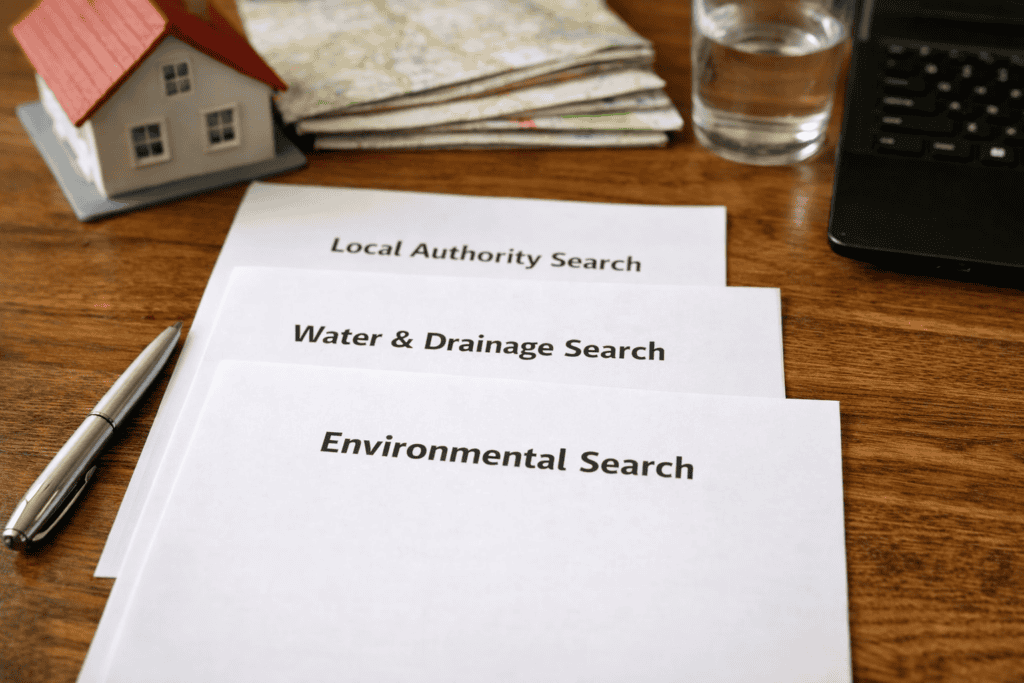
Conveyancing searches are formal enquiries sent to third-party authorities during a property purchase. They reveal legal, environmental, and infrastructural risks that do not appear on a title register. Most residential transactions in England and Wales require at least three core searches: local authority, water and drainage, and environmental. Each search targets a distinct category of risk. This section explains what each search covers, what it can uncover, and how the results affect a buyer’s decision to proceed.
Key takeaways
- Order conveyancing searches as soon as your offer is accepted to avoid delays.
- The LLC1 and CON29 documents show planning restrictions, enforcement notices, and road adoption status.
- A public sewer crossing your boundary can restrict building work and affect mortgage conditions.
- Environmental searches cross-reference historical land use, landfill proximity, and ground stability data.
- Contamination or flood risk flags can trigger specialist reports that take two to four weeks.
- Lenders may withdraw mortgage offers or require specialist insurance based on search results.
- Unresolved planning breaches identified before exchange can leave buyers facing enforcement costs of thousands.
What Conveyancing Searches Are and When They Are Ordered
Sources: Property Industry Eye — Home Sale Pack (2024); Carbon Law Partners (2025); Country Life — Quick Move Now (2025)
Order conveyancing searches as soon as your offer is accepted. Waiting until later in the transaction can cause delays that push your completion date back by weeks. Your solicitor submits the searches on your behalf, usually within the first two weeks after receiving your draft contract pack from the seller’s solicitor.
Searches are formal enquiries sent to third-party bodies, including local authorities, water companies, and environmental data providers. They request information about the property that the Land Registry title and the seller’s own disclosures cannot supply. Each search covers a distinct risk category, so the results complement each other rather than overlap.
Most mortgage lenders require searches as a condition of their offer. Even when buying property without a mortgage, skipping them leaves you exposed to liabilities that attach to the land itself, not the seller. That means they transfer to you on completion regardless of what the seller knew or disclosed.
Local Authority Searches: Planning History, Restrictions, and Road Adoption
Missing a planning restriction before exchange can leave you liable for enforcement costs running into thousands of pounds. A local authority search shows what the council holds on record about the property and the surrounding area.
The search returns two core documents. The LLC1 (Local Land Charges Register) discloses financial charges, tree preservation orders, listed building status, and enforcement notices. The CON29 covers road adoption status, pending planning applications, compulsory purchase orders, and conservation area designations.
Road adoption status can affect costs directly. Residents, not the council, maintain unadopted roads. If you know this before exchange, you have time to renegotiate the price or request a road bond from the seller.
Searches typically cost £100–£250, with turnaround times ranging from 48 hours in some London boroughs to over three weeks in rural areas. Personal searches, carried out by a third-party agent, often return faster but offer slightly less indemnity cover. These costs sit within the broader solicitor fees you will pay at completion. If the results flag a nearby large development, that information is legitimate grounds to reassess before exchange.
Water and Drainage Searches: Sewer Proximity, Flood Risk, and Supply Records
England flood risk: 6.3 million properties in total are in areas at risk of flooding from one or more sources. Surface water risk has increased 43% since the Environment Agency's 2018 assessment. By mid-century, climate change could put 1 in 4 properties at risk.
Source: Environment Agency — National Assessment of Flood & Coastal Erosion Risk in England (Dec 2024)
Sewer proximity catches buyers off guard more often than most issues. A public sewer beneath or near a property can limit what you can build. Some lenders also impose conditions when sewers cross within the boundary. Building over one without water authority approval can trigger enforcement action and costly remediation.
A water and drainage search through CON29DW confirms mains water and sewer connections. It also maps any public sewers within the boundary, clarifies maintenance responsibilities, and records whether the property falls within a water authority flood risk zone. This sits separately from, but complements, Environment Agency flood mapping.
Supply records confirm the drinking water source and show whether charges are metered or rateable value-based. That affects running costs directly, so it should be factored into any budget calculation before exchange. Rural properties on private boreholes or shared supplies need extra due diligence on water quality and maintenance responsibilities before exchange.
Environmental Searches: Contaminated Land, Landfill Sites, and Ground Stability
Properties on or near former industrial land, closed landfill sites, or unstable ground can carry liabilities that a structural survey may miss. An environmental search, submitted to a specialist provider such as Landmark Information Group, cross-references historical land-use records, Environment Agency data, and geological surveys. It identifies contamination risk, landfill proximity, and ground stability concerns, including subsidence and mining activity.
Contaminated land carries the most serious financial consequence. Under the Environmental Protection Act 1990 Part IIA, current owners can be held liable for remediation costs even if contamination predates their ownership. If a search flags risk, your solicitor will typically recommend an indemnity policy or a specialist desktop study before you proceed.
Lenders may treat high-risk environmental results as grounds to decline a mortgage offer, so it is essential to resolve flagged issues before exchange. Ground stability results need equal scrutiny in areas with a history of coal or salt mining. A positive result may require further investigation through the British Geological Survey or a structural engineer before exchange.
How Search Results Affect Mortgage Offers, Insurance, and Completion Timelines
In 2024, 28.8% of UK property sales fell through before completion. The two biggest causes directly linked to due diligence were buyers walking away after survey results (27.3%) and failure to secure a mortgage (22%). Early, thorough conveyancing searches reduce exposure to both risks.
A problematic search result does not always stop a purchase, but it can change how the deal moves forward. Lenders may withdraw mortgage offers, impose retention clauses, or require specialist insurance before releasing funds. Flags for contaminated land, flood risk, or unresolved planning permission breaches can trigger a specialist report that takes two to four weeks to return, pushing completion back even when both parties are ready to exchange.
Environmental and drainage issues often resolve through indemnity insurance rather than remediation. Policies covering low-risk flags cost a few hundred pounds and can be arranged within days. Active contamination, building-over-sewer violations, or ground instability need more substantial responses, and some lenders may decline the property as security entirely.
Order searches early so your solicitor has time to address findings before exchange becomes urgent. Delays caused by adverse results late in a chain are much harder to absorb when other buyers and sellers are working to a fixed date.
Frequently Asked Questions
What does a local authority search reveal during conveyancing?
A local authority search checks council records for planning permissions, enforcement notices, road schemes, and listed building restrictions that affect the property. It covers both the official register and extra enquiries about nearby proposals. The results help buyers understand any legal duties or development constraints tied to the land.
What information is included in a water and drainage search?
A water and drainage search confirms whether a property is connected to the public water supply and public sewer. It also shows whether any public sewers run across the plot, which can restrict building work. Thames Water and other regional providers supply this data directly to conveyancers.
What can an environmental search show about a property?
Review the environmental search report before exchanging contracts. It highlights contaminated land, historic industrial use, nearby landfill sites, flood risk from rivers or surface water, and ground stability issues such as subsidence or sinkholes. Any of these can affect insurability, mortgage lending, and long-term property value.
Are local, water and environmental searches mandatory when buying a property?
Cash buyers have no legal duty to commission conveyancing searches. Mortgage lenders, however, require local, water, and environmental searches before they release funds, which makes these searches effectively mandatory for most purchases. Solicitors also strongly advise them for cash transactions because they can reveal undisclosed liabilities that could affect the property’s value or use.
How long do conveyancing searches usually take to come back?
Local authority searches typically take 2–6 weeks. Some councils return results in under 5 days, while others exceed 10 weeks during busy periods. Water and drainage searches usually complete within 5–10 working days. Environmental searches are often faster and return results digitally within 24–48 hours.